Posts

Reflection on Interest Approach Lab: Different Lab Group, Different Challenges

Image
Interest Approach Lab: Different Lab Group, Different Challenges Because of my schedule this last week I had to swap Teaching Practice Labs with another member of my cohort.  What this meant is I got the chance to teach a new group of students.  Here are some of my lessons I learned during this time. Interest Approaches: Are so much fun.  They help students think about something and then get interested in what to expect for the rest of class.  I like to use two types of interest approaches: Unit Based, and Lesson Based. Unit Based An interest approach which gets students interested in the overall unit by making students see value in what they will learn. Lesson Based An interest approach which gets students interested in the lesson for the day.  To me these are two different ideas because they both provide a different value. A Unit Based Interest Approach gets students interested in what they will be learning for the unit, while a lesson b...

Here are my Objectives

Image
Here are my Objectives Walking into week five this semester I want to briefly ask one question: What are my goals when I teach a single lesson ? With that question in mind I have to remind myself that every day I will have students for 42 minutes and as M. Susie Whittington put it, Objectives Create the Mindset for Learning. So if I want my students to learn about say the differences between animal breeds instead of a knowledge level objective if I have a Synthesis or Evaluation Level objective the students will be able to learn even more. Instead of saying: Students will Identify Different Swine Breeds Students will List Different Beef Cattle Breeds Students will Label Different Horse Breeds Make them Learn: Students will Decide which Swine Breed will work in a particular situation Students will Create a Twitter account on different  Cattle Breeds Students will Evaluate and Appraise different horse breeds What is the difference between these three objective...

Reflection on First Day Lab: When Things Don't Go As Planned

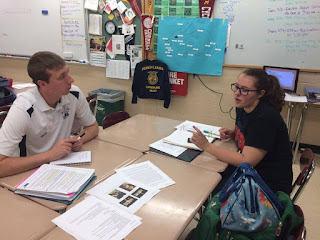
Reflection on Lab 1: When Things Don't Go As Planned When thinking back on the lesson I preformed on Wednesday Morning I can't help but realize that my number one critic will always be myself.  Seeing how it was in a lab group I was only teaching four individuals. Here were the identified problem students in the class right away: Miss Sleeps A Lot Miss On Her Phone . . . The Entire Time Miss Argues With The Teacher I give the girls these titles in the lab because in the first minute I identified each of these "problem children" which I suppose would be considered a good thing but then I did what I probably shouldn't have done. I panicked. Instead of thinking "This is how you were trained to handle this" I went internally and said "Why don't you want to pay attention? Am I too boring? Do they not like my lesson?" And so when the chaos of the 10 minutes finally ended I was defeated internally. Thinking back on it though, I didn...

Explore Cumberland Valley FFA Chapter

Image
Explore Cumberland Valley FFA Chapter Check out the cool video I completed for a AEE 295 Assignment. In this video blog you'll see me exploring the vast depths which makes up the Cumberland Valley FFA Chapter from the students, advisors, and support networks which work behind the scene. Let me know what questions you have in the comments below. To Be Continued . . .

Weekly Investment: Learning to Write Lesson Plans

Image
How do we Design and Plan Instruction? Finally we begin talking about one of the most important aspects of teaching: How are you going to teach every day? It brings back a memory one of my teachers in high school once told me: Teaching is like acting. Everyday you have to read a new script and hope that your students enjoy the show.     As I read the pages trying to glean some new information I instead decided that I should hit the web and look at some lesson plans to better understand everything: Unit Plans: These are the big concepts you want to cover. So for example in a Dairy Foods Class I may want to cover these questions: Where does milk come from? What is the difference between milks? How is butter made? How is ice cream made? How is yogurt made? That would be a Unit. A Lesson would be taking one of those big concepts and breaking it down. For example I could have a class with a 30 minute lecture on ice cream making. Followed by a couple of days...

Reflection of Supervised Agricultural Experiences

Image
Reflection on the Importance of Supervised Agricultural Experiences in Youth Development “SAEs are Experiential service and/or worked-based learning through the implementation of a supervised agricultural program” is a direct quote from the National FFA Organization on SAEs.    Here is my disclaimer: My knowledge behind SAEs has been what I have seen and talked to with students, FFA Alumni, and Ag Teachers.   If you would have asked me what an SAE was years ago I would have said something like: Project Animals, Crop Growing, Agribussiness, Job Shadowing.   Now that I’m trying to prepare myself to be an FFA Advisor in training this spring I am starting to get a better idea of the purpose of SAE. During my one visit to Cumberland Valley FFA Chapter I met one of the girls who is working on an agriscience fair project. This is kind of like a science fair project but has its own twist.   This is how she determined her project topic: “At f...